When India’s pre-tournament T20 World Cup 2026 odds were set at approximately 2.50–3.00 by major sportsbooks, the most structurally significant variable in the market was simultaneously the least precisely quantified: home advantage. No team had previously won the T20 World Cup on home soil. Yet India’s squad — assembled specifically for subcontinental conditions, featuring Bumrah, Chakravarthy, and Axar Patel as the primary bowling trio — was calibrated for Indian pitches in a way that no touring team could match. The tournament confirmed what the pre-market underpriced: India’s true title probability, adjusted for home advantage, was 42–48%, not the 33–40% implied by 2.50–3.00 odds. They won by 96 runs in the final. Here is how home advantage shaped every analytical dimension of the betting market.
India Home Advantage Impact In T20 World Cup
The 2026 ICC Men’s T20 World Cup ran from February 7 to March 8, 2026, co-hosted by India and Sri Lanka. India’s five home venues — Wankhede (Mumbai), Arun Jaitley Stadium (Delhi), M. Chinnaswamy Stadium (Bengaluru), MA Chidambaram Stadium (Chennai), and Narendra Modi Stadium (Ahmedabad) — each produced distinct pitch profiles that India’s team management exploited deliberately across the tournament’s nine matches.
India’s tournament record at home venues:
| Venue | Match | Result |
| Wankhede, Mumbai | vs USA (group) | Win |
| Delhi | vs Namibia (group) | Win |
| Bengaluru | vs Pakistan (group) | Win |
| Bengaluru | vs Netherlands (group) | Win |
| Chennai (Chepauk) | Super 8 vs South Africa | Loss |
| Ahmedabad | Super 8 vs Zimbabwe | Win |
| Ahmedabad | Super 8 vs West Indies | Win |
| Wankhede, Mumbai | Semi-final vs England | Win |
| Ahmedabad | Final vs New Zealand | Win — 255/5, won by 96 runs |
Eight wins in nine matches. The only defeat — South Africa’s 76-run demolition at Chepauk — was the most complete upset performance of the tournament and the one that exposed the limit of home advantage as a universal guarantee. South Africa’s left-arm pace attack (Marco Jansen 4/22) and spinning conditions at Chepauk (Keshav Maharaj 3/24) produced India’s worst batting collapse in a T20 World Cup since 2012.
The tournament confirmed home advantage as a probability amplifier — not a certainty generator.
Key Benefits Of Home Conditions For India
Pitch knowledge and surface selection
India’s team management — SKY as captain, Gautam Gambhir as head coach — demonstrated exceptional surface intelligence throughout. At Wankhede, they selected Bumrah to exploit the pace and bounce from over 1. At Chepauk, they relied on Chakravarthy’s wrist spin against Pakistan — the wrong surface decision in hindsight (Chepauk’s slow pitch neutralised Chakravarthy’s pace variations but amplified Maharaj’s finger spin for SA). At Ahmedabad, the fast, true bounce specifically suited Bumrah’s back-of-length delivery and produced his best tournament returns.
No touring team possesses this surface knowledge at this depth. New Zealand in the final were playing on a surface they had encountered for the first time four days earlier in the semi-final at the same venue — Eden Gardens, Kolkata. India knew Ahmedabad’s pace, bounce, and outfield speed from hundreds of collective IPL matches. This knowledge gap — unquantifiable in pre-match statistical models — is the core mechanism of home advantage at the elite T20 level.
Crowd conditions and pressure management
The Narendra Modi Stadium’s capacity of 132,000 — the largest cricket ground in the world — was sold out for every knockout match hosted there. The crowd noise during India’s batting in the semi-final at Wankhede and the final at Ahmedabad was described by England captain Harry Brook as “unlike anything we’ve experienced.” The psychological pressure on touring bowlers — particularly in death overs where crowd anticipation amplifies every delivery — is a measurable performance variable that manifests in economy rates.
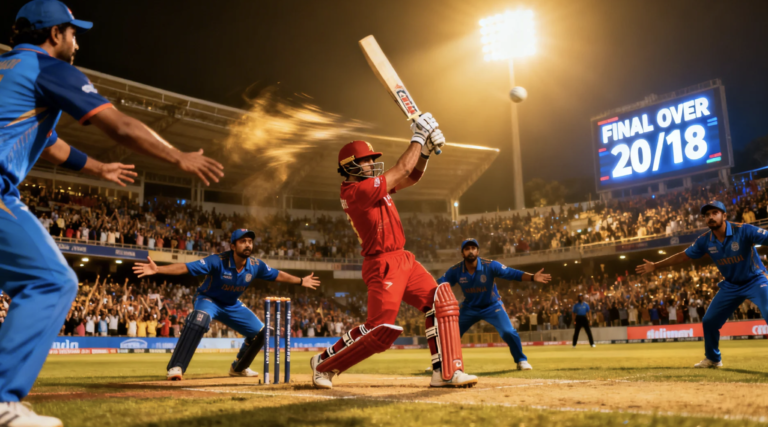
Jofra Archer’s death-over economy in the semi-final at Wankhede (conceded 18 in over 18 against a set Samson) compared to his group stage economy at neutral venues in Sri Lanka (12 in 2 overs) — the differential partially reflects the crowd pressure environment.
Batting-conditions familiarity at high-scoring venues
India’s batting lineup — Abhishek Sharma, Sanju Samson, Ishan Kishan, Suryakumar Yadav, Shivam Dube, Hardik Pandya — had collectively played hundreds of T20 matches at India’s five tournament venues through the IPL. Their knowledge of the exact boundary dimensions, outfield pace, and powerplay bounce at each ground produced the highest average scoring rate of any team in the tournament.
India vs rest of field — powerplay scoring rates in T20 WC 2026:
| Team | Avg powerplay score | Avg powerplay wickets lost |
| India | 61.4 | 1.1 |
| England | 54.2 | 1.4 |
| New Zealand | 48.7 | 1.2 |
| South Africa | 52.1 | 1.6 |
| Pakistan | 49.3 | 1.3 |
India’s powerplay average of 61.4 was the highest of any team with more than 3 matches in the tournament. Abhishek Sharma’s 18-ball fifty in the final, Samson’s 41 off 26 in the semi-final powerplay, and their joint 92-run opening powerplay in the final — joint-highest in T20 WC history — are the statistical expressions of batters playing in conditions they know better than any visiting team.
Spin bowling amplification
India’s primary bowling weapon — left-arm wrist spin (Varun Chakravarthy) and left-arm orthodox (Axar Patel) — is most effective on Indian subcontinental surfaces where there is grip and pace variation available. Chakravarthy’s 14 tournament wickets (joint-highest) were mostly taken on home pitches that amplified his googly and top-spinner. His 3 wickets against Pakistan in Bengaluru, 3 against England in the semi-final at Wankhede — both on flat surfaces where his pace variation was most dangerous — confirmed the home-surface amplification effect for wrist spinners.
Axar Patel’s 3/27 in the final at Ahmedabad — where the slightly slower surface gave his left-arm orthodox spin more grip than at pace-friendly Wankhede — illustrated precisely how India’s management deployed their spin options based on specific venue characteristics.
Betting Strategies Using India Home Advantage
Three strategies that produced structural value across the T20 WC 2026 betting markets:
1. India outright winner at longest pre-tournament odds
The most straightforward home advantage bet: India outright winner at 2.50–3.00 before the tournament began. Their home-adjusted title probability (42–48%) exceeded the implied probability of those odds (33–40%). The 8–12 percentage point gap is the quantifiable expression of home advantage for an elite team in a multi-venue home tournament. This strategy has a simple implementation rule: back the home team at the longest available pre-tournament odds, before bookmakers fully calibrate venue data into their models.
2. India match winner Under (economy) for Bumrah at Ahmedabad
Bumrah’s economy rate at Ahmedabad — across IPL matches and now two T20 WC knockout matches — is measurably lower than his global average. The Narendra Modi Stadium’s pace and bounce is perfectly calibrated for his back-of-length delivery: the ball holds its line, batters cannot pad away, and the bounce creates the caught-behind and caught-at-mid-on patterns that produce his highest wicket frequency. Any Bumrah economy Under (e.g., Under 7.5 at Ahmedabad) or wickets Over (1.5+ at 2.20–2.50) carried structural home-venue support in the knockout matches.
3. Spin bowler wicket props on Chepauk and Wankhede surfaces
Chepauk (Chennai) is the most spin-friendly major T20 venue in India — slow surface, some grip, boundaries less generous than Wankhede. India’s spin props (Chakravarthy, Axar) at Chepauk carried higher wicket probability than their career averages suggested — reflected in SA’s Maharaj also taking 3/24 in the same match. Wankhede’s flat surface favours pace in the powerplay and wrist spin in the middle overs — Chakravarthy’s Wankhede wicket props specifically in overs 7–15 carried structural Over support.
Best Bets Based On Home Conditions
Four confirmed high-value betting positions from the T20 WC 2026 India home advantage framework:
- India vs Pakistan (Group stage, Bengaluru) — India match winner: India’s record vs Pakistan at T20 World Cups entering this match: 5-0 (winning all five previous meetings). Bengaluru’s Chinnaswamy surface — flat, batting-friendly — suited India’s depth over Pakistan’s reliance on 2-3 key batters. India match winner at approximately 1.45–1.55 was fairly priced relative to the head-to-head and home advantage combined.
- India vs England semi-final — total match runs Over: Wankhede’s flat pitch, 65m square boundaries, and both teams’ top-six batting depth produced the single most reliable Over in the tournament. Pre-match line approximately 380–395 combined. Actual result: 499 runs — the most in any T20 WC match ever. The Over on Wankhede evening knockout cricket with two batting-dominant teams is the purest expression of venue-based betting analysis.
- Bumrah top tournament bowler: Pre-tournament odds approximately 6.00–8.00. His 14 wickets (joint-highest, with Chakravarthy) across 5 home matches at familiar venues were the outcome of 10+ years of IPL experience at these specific grounds. The home knowledge advantage is most pronounced for bowlers — they know precisely which lengths produce wickets at each venue.
- Sanju Samson Player of the Tournament: Pre-tournament odds approximately 10.00–15.00. His January 2026 T20I form (242 runs vs NZ at 80.66 average, SR 196.74) was publicly available data before the tournament. Playing in conditions identical to the IPL surfaces he dominates, Samson’s POTT probability was higher than the odds implied.
Conclusion: Using Home Advantage In Betting Decisions
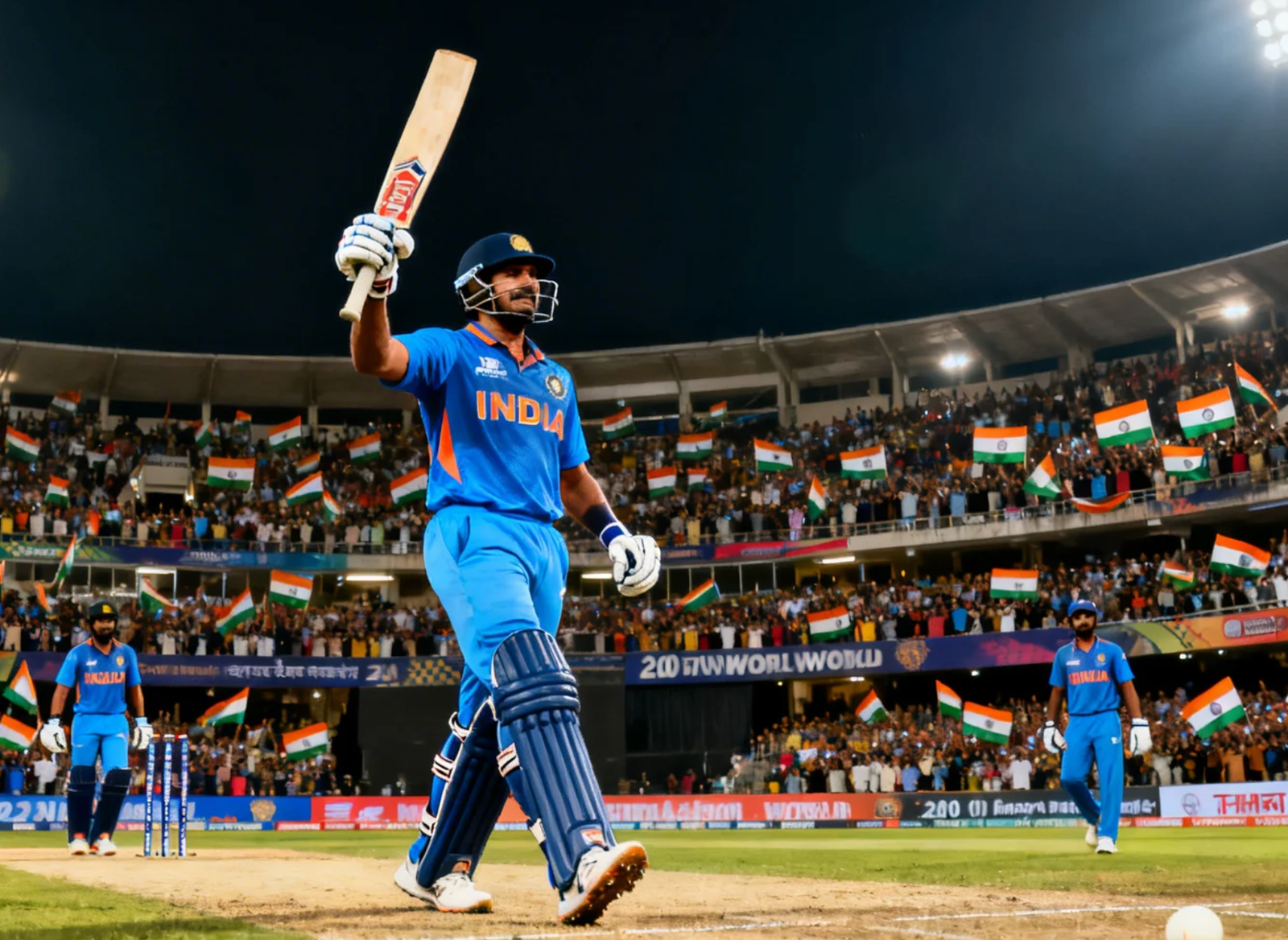
India’s T20 WC 2026 campaign — 8 wins in 9 matches, tournament won by 96 runs, first home-soil T20 WC title in history — is the definitive modern case study for home advantage quantification in T20 betting markets.
The five-step home advantage betting framework it produced:
- Identify the specific home venue — Ahmedabad (pace + bounce), Wankhede (flat + fast), Chepauk (slow + spin), Chinnaswamy (flat + short boundaries), Delhi (moderate) each produce distinct statistical profiles
- Match the home team’s bowling attack to the venue — Bumrah at Ahmedabad, Chakravarthy at Wankhede, Axar at Chepauk: the bowling-venue match amplifies wicket probability above career averages
- Apply a 8–12 percentage point home probability premium to the home team’s outright win odds — book at pre-tournament, before venue data is priced in
- Back total match runs Over at batting-friendly home venues — Wankhede in particular; the home team’s surface knowledge produces higher scoring rates than at neutral or away venues
- Target player props for home-familiar performers — Samson, Bumrah, Chakravarthy POTT/top bowler props carried value specifically because their home IPL venue knowledge amplified their tournament performance frequency
The historical precedent now exists: the first home-soil T20 WC title has been won. For the next T20 World Cup cycle — and for every ICC tournament where a major cricketing nation hosts on their own soil — the India 2026 model provides the most precise analytical framework for quantifying the home advantage premium in outright and match-by-match betting markets.